
Summary of the Plenary Session on the Adoption of the 2026–2030 Development Plan Law
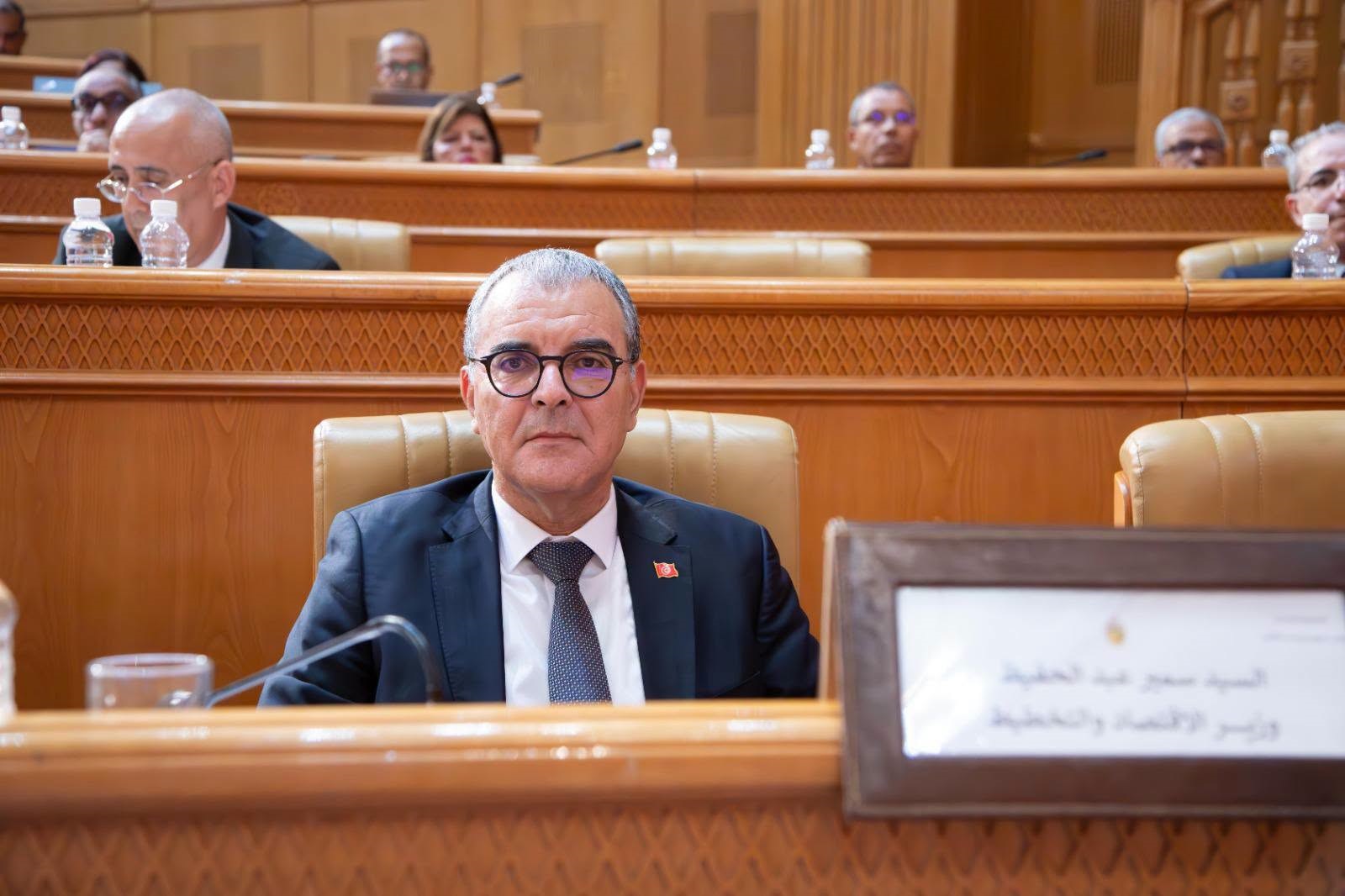
The National Council of Regions and Districts held a plenary session on Friday, 17 July 2026, dedicated to the consideration and adoption of the draft law approving the 2026–2030 Development Plan, under the chairmanship of Mr. Imed Derbali, President of the National Council of Regions and Districts, in the presence of Mr. Samir Abdelhafidh, Minister of Economy and Planning, and the accompanying ministerial delegation.
At the opening of the session, the President of the Council welcomed the Minister of Economy and Planning, senior state officials, and members of the local councils attending the proceedings. He paid tribute to all members of the local, regional and district councils for their contribution to the preparation of the Development Plan, highlighting the bottom-up approach adopted in defining the country’s development priorities.
Following quorum verification in accordance with the Council’s Rules of Procedure, the Committee on Development Plans and Major Projects presented its report on the draft law, after which the floor was opened for general debate.
Members stressed the importance of the participatory approach adopted in preparing the Development Plan and the key role played by elected councils in reflecting citizens’ expectations at the local, regional and district levels. Several speakers emphasized that the Plan should promote equality of opportunity and balanced development among all regions and districts.
Members also called for the necessary guarantees to ensure the successful implementation of the Plan and its projects, while advocating stronger parliamentary oversight mechanisms to monitor project execution.
The discussions further highlighted the need to accelerate digital transformation, reform the education and training systems, align vocational training with labour market needs, improve the investment climate, strengthen support for small and medium-sized enterprises, reduce administrative bureaucracy and continue developing infrastructure.
Several interventions also underlined the importance of reinforcing national sovereignty through food, water and energy security, considering these strategic priorities essential for ensuring the country’s stability and resilience in the face of global challenges.
Responding to Members’ remarks, Mr. Samir Abdelhafidh, Minister of Economy and Planning, commended the quality of the debate, noting that it reflected a broad consensus on the country’s key development challenges and priorities, as well as a shared commitment to strengthening the social state, promoting equality between regions and districts, and building a more productive and wealth-generating economy.
The Minister pointed out that, for the first time, the Development Plan had been submitted to the National Council of Regions and Districts for debate and approval under a governance approach based on grassroots participation and popular sovereignty. He explained that proposals submitted by elected councils went beyond individual projects to include comprehensive development visions, territorial assessments and practical recommendations, all of which were carefully examined in light of national priorities and available resources.
He added that the Plan establishes the framework for implementing the country’s new territorial organization while preserving national unity and ensuring that development priorities originate from local realities, within the limits of fiscal sustainability and the State’s financial capacity.
The Minister explained that the Plan is founded on several strategic choices, foremost among them strengthening national sovereignty, enhancing self-reliance and promoting international partnerships that serve Tunisia’s national interests.
He stated that the Plan aims to achieve 4% economic growth, increase per capita income, reduce poverty, improve purchasing power, strengthen public financial balances, enhance domestic resource mobilization, improve the performance of public enterprises, accelerate digital transformation and integrate 50% of the informal sector into the formal economy.
According to the Minister, achieving these objectives requires modernizing the institutional and legislative framework, accelerating digitalization, stimulating wealth creation and strengthening cooperation between the public and private sectors. He emphasized that these ambitious yet realistic objectives represent a national commitment requiring the collective efforts of all stakeholders.
The Minister also announced that a portfolio of priority projects had been prepared in close coordination with the elected councils. These projects cover infrastructure development, renewable energy, agriculture, industry, education, higher education, vocational training, scientific research, healthcare, and improved access to quality public services across all regions.
He stressed that the success of the Plan will ultimately be measured by its effective implementation and by the ability to translate planned projects into concrete achievements through increased investment. In this regard, he underlined the important oversight role that the National Council of Regions and Districts will play in monitoring project implementation.
Finally, the Minister reaffirmed that the Development Plan is built around five strategic pillars: promoting inclusive and equitable social development, modernizing the economy and infrastructure, reforming the institutional framework, improving the efficiency of public services, and strengthening trust between the State and citizens, while enhancing national competitiveness, making better use of national resources, advancing structural reforms and investing in human capital.
At the conclusion of the debate, the draft law approving the 2026–2030 Development Plan was adopted by 56 votes in favour, 6 votes against, and 5 abstentions.